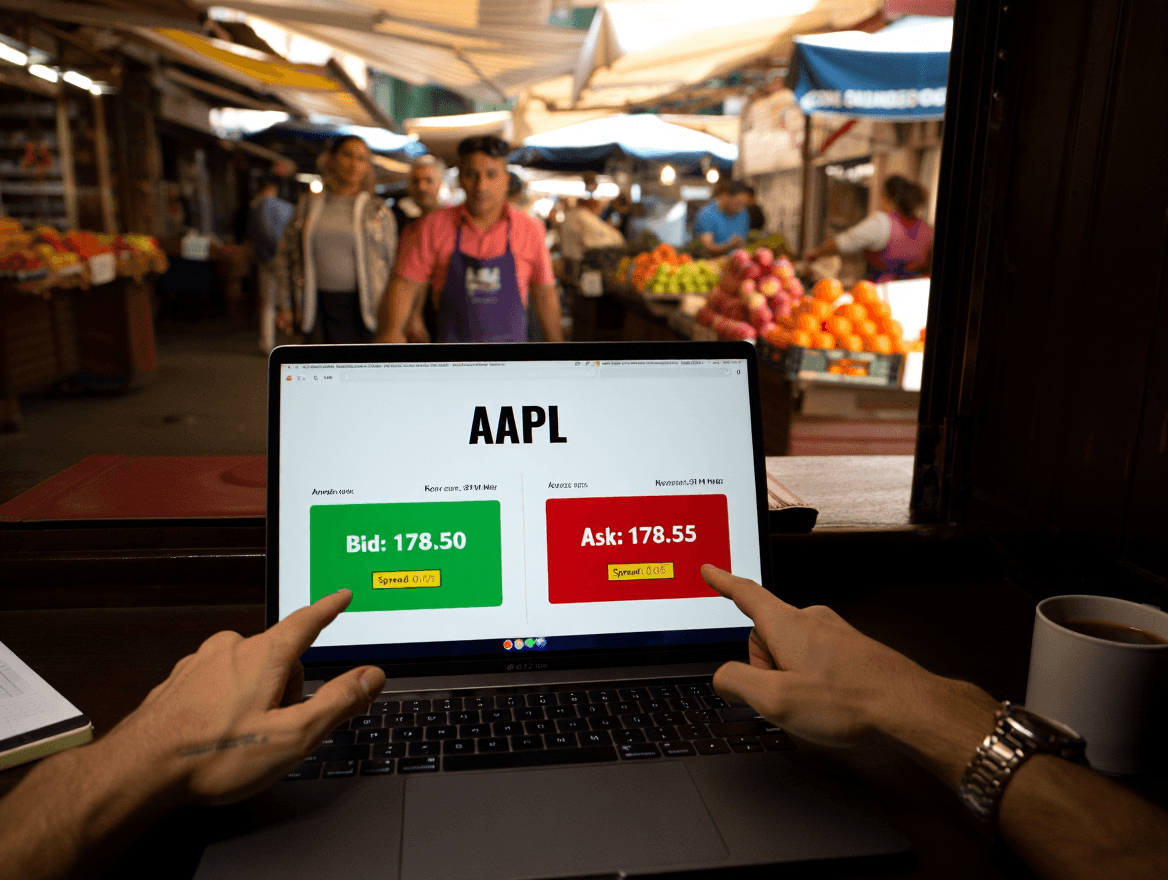
Bid-Ask Spread Explained: The Hidden Cost Beginners Often Miss
Learn what the bid-ask spread is, how it affects execution, and why liquidity matters when reading prices.
Learn what the bid-ask spread is, how it affects execution, and why liquidity matters when reading prices.
The bid-ask spread is the difference between the highest price buyers are currently willing to pay and the lowest price sellers are currently willing to accept. The bid is the buyer side. The ask is the seller side. If the bid is 20.00 and the ask is 20.05, the spread is 0.05. That small gap can affect every trade, especially when trading often or using market orders.
Beginners often focus on the last traded price, but the last price is not always the price they can get. Investor.gov warns that the last-traded price is not necessarily the price at which a market order will execute. For a market buy order, the trader usually pays near the ask. For a market sell order, the trader usually receives near the bid. This means a position can start at a small disadvantage immediately.
The spread is closely tied to liquidity. A liquid stock usually has many buyers and sellers, which can create a tighter spread. A thinly traded stock may have fewer participants, which can create a wider spread. Nasdaq explains that a smaller spread often suggests higher liquidity, while a larger spread can suggest lower liquidity. This is why a low-priced stock is not automatically cheap to trade.
The spread matters most when trades are short-term. If a trader aims for a small move, a wide spread can consume a large part of the planned gain. For example, if a stock has a 0.20 spread and the trader is only targeting 0.40 of movement, half of the expected move is already affected by entry and exit friction. That does not mean the trade is impossible, but it changes the math.
Order type also matters. A market order prioritizes execution. It may cross the spread immediately. A limit order gives price control, but it may not fill. This trade-off connects directly to market, limit, and stop orders. A trader who understands the spread can choose the order type with more realistic expectations.
Spreads can change during the day. They may be wider near the open, around news, during low-volume periods, or outside regular market hours. This is one reason beginners should be careful with premarket and after-hours trading. The displayed price may look attractive, but the bid and ask can tell a different story.
Paper trading can help, but only if the simulator uses bid and ask data realistically. Some virtual platforms fill too easily, which hides the cost of the spread. A better practice is to record the bid, ask, and planned order type before entering a simulated trade. This makes the exercise closer to live conditions.
The bid-ask spread is not a fee charged by a broker in the usual sense. It is part of market structure. But it still affects the effective cost of trading. Anyone learning to read quotes should look at bid, ask, spread, volume, and time delay together. Those details explain why the price on the screen may not match the price in the account.
Understanding the spread makes trading less mysterious. It shows why liquidity matters, why order choice matters, and why the last price is only one piece of information. For beginners, this is one of the most useful market data lessons to learn early.
Sources: Nasdaq on bid-ask spreads; Investor.gov on market order execution.
Return to the archive and continue with the next practical trading lesson.